CoryDora: What Shipping an Open Hardware Macropad Taught Me
I go to a lot of meetups and conferences, and for a long time I had this habit of carrying small 3D printed things with me.
Nothing particularly serious. Just random little gimmicks, tiny prints, keychains, and whatever else I happened to have made recently. I’d take a few with me and hand them out to people I met, especially students.
I liked doing that, but after a point I wanted to make something a little more concrete.
Something that was still small and approachable, but also something a person could sit down and build. Something that could be their first real hardware project.
That is more or less where CoryDora came from.
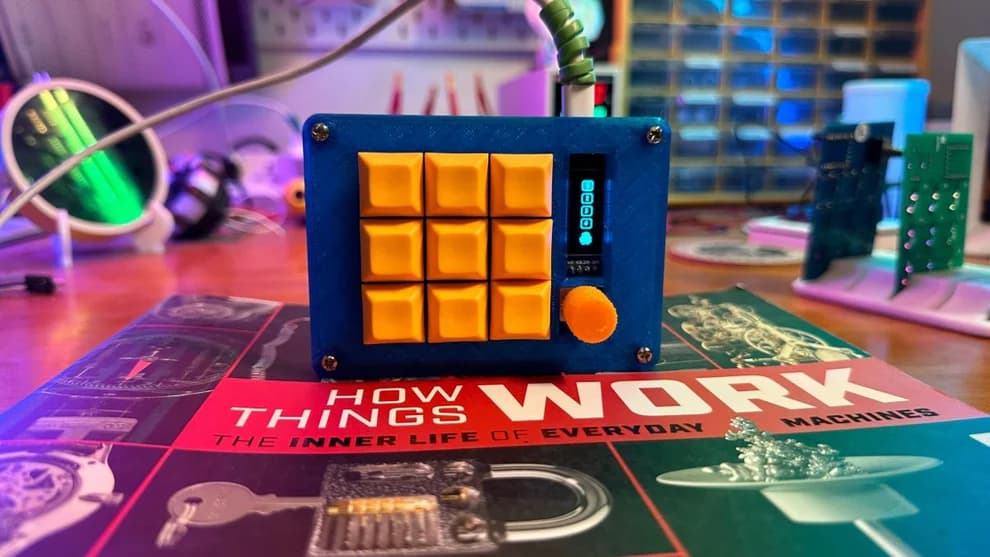
CoryDora is an open-source 3×3 macropad. It has nine hot-swappable MX switches, an OLED display, a rotary encoder, and it runs QMK.
And yes, it is named after the corydoras catfish. I keep fish. I like corydoras. There was never any chance I was going to waste an opportunity like that.
Someone’s first hardware project
From the beginning, I wanted CoryDora to be something I could hand to someone who had never really built electronics before.
Their first PCB.
Their first soldering project.
Their first mechanical keyboard-adjacent thing.
Maybe even the first time they looked at a board and actually understood what was happening instead of treating it like a mysterious green rectangle.
That is why the board is a 3×3 macropad.
Nine keys are enough to make it useful, but not so many that it becomes intimidating. The circuit is also small enough that you can actually follow it. A switch goes through a diode, reaches the microcontroller, and the firmware turns that into a key press. It is not hard to explain, and more importantly, it is not hard to understand.
I wanted someone building it to feel like they were learning something, not just soldering parts together because I told them to.
The OLED and rotary encoder are there because I still wanted it to be a fun macropad when it was done. The switches are hot-swappable because once you let mechanical keyboard people into the room, switch opinions become inevitable.
QMK did a lot of heavy lifting on the firmware side. That way the hardware could stay simple, and whoever built it could still remap the board without me having to create a custom firmware stack from scratch.
The RP2040 Zero
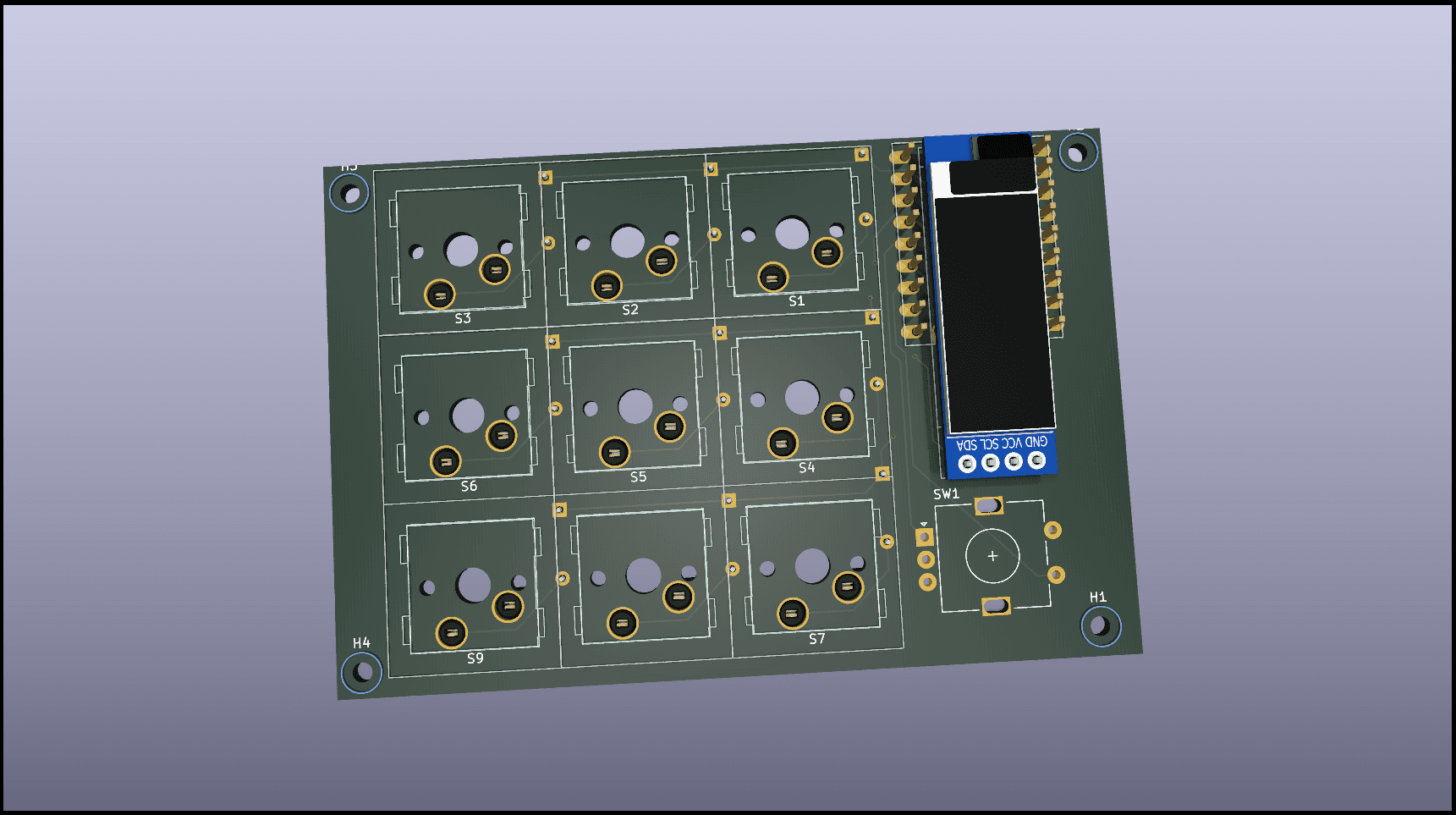
I used an RP2040 Zero module rather than putting the RP2040 directly on the PCB.
Partly because it was cheap. Partly because it was supported by QMK. Mostly because it kept the whole thing simple.
If CoryDora was meant to be somebody’s first soldering project, then using a small module made more sense than adding all the supporting circuitry for the microcontroller directly to the board.
The rest of the bill of materials followed the same idea.
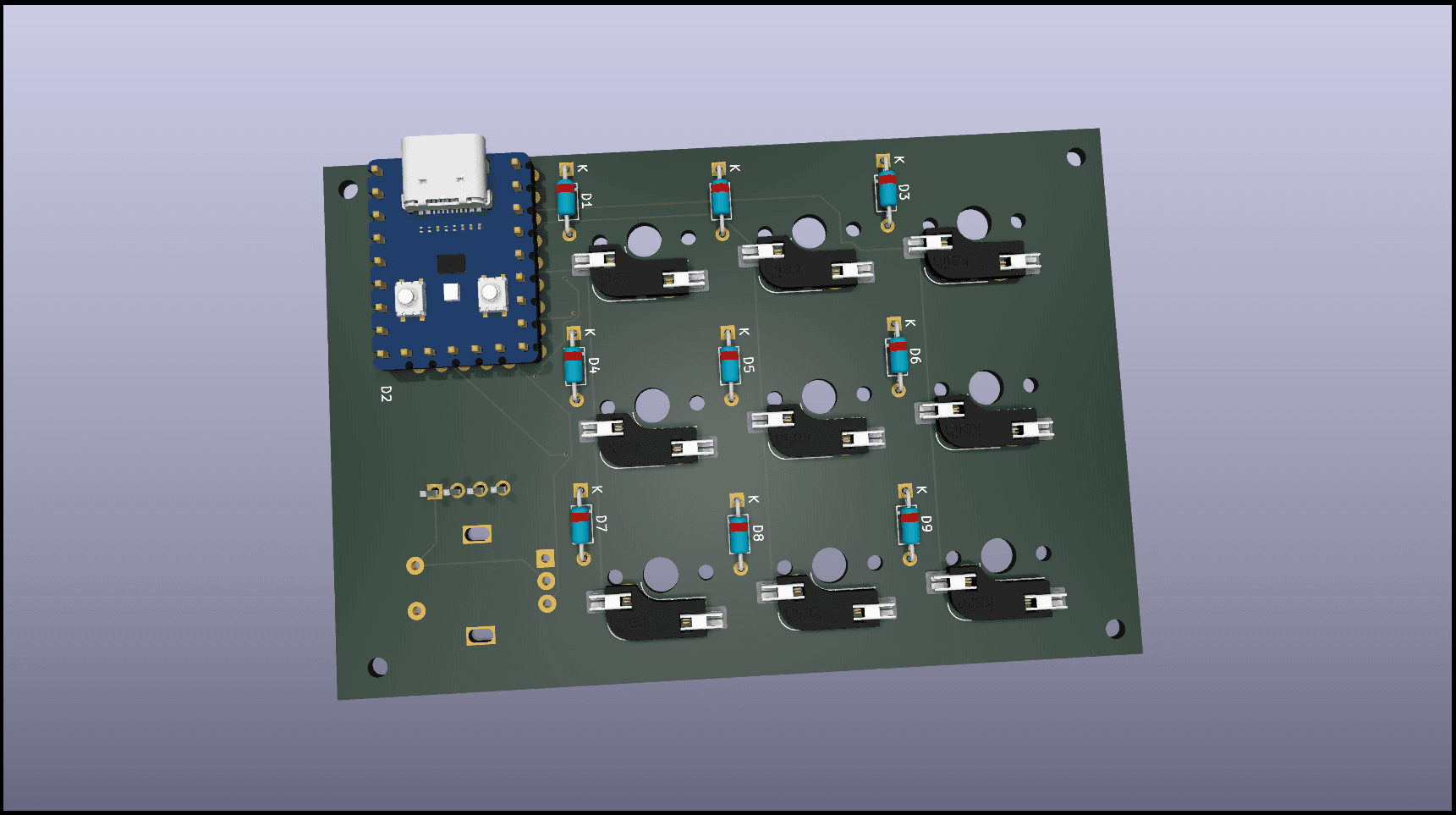
Through-hole diodes.
Standard MX-compatible switches.
Hot-swap sockets.
A small I2C OLED.
A fairly normal rotary encoder.
Nothing on the board was meant to feel exotic or hard to source.
But that turned out to be true only if you were building one of them.
I wasn’t actually planning to sell these
Originally, CoryDora was not really a product in my head. It was something I wanted to make and give away.
That changed because Amit basically convinced me to make a small batch and try selling them at IndiaFOSS.
So I made a small batch.
Then I put out a post on Twitter saying I had ten units and that people could come buy them at IndiaFOSS.
I really did not expect much beyond a few people finding it interesting and maybe picking one up if they happened to be around.
That is not what happened.
People showed up specifically to buy CoryDora.
A few people literally came to the conference, bought one from me, and left.
That was the moment it stopped feeling like just another fun side project and started feeling like something with a life of its own.
It was a very funny experience, but it also changed how I thought about the project. Up to that point, CoryDora was just something I had made. Now it was something people wanted, which is a different problem.
Making one is easy. Making ten is a different problem.
When you are building one piece of hardware for yourself, sourcing is flexible.
If one vendor is expensive, you wait.
If they are out of stock, you buy from someone else.
If the exact switches you wanted are unavailable, you just choose a different switch.
You have a lot of freedom because you only need enough parts to make one.
The moment you try to make ten of the same thing, that freedom disappears.
Now I needed to know where the next ten RP2040 Zeros were coming from.
I needed to know whether the switches I used last time would still be available.
I needed to know whether I could get the same keycaps again, at something resembling the same price.
And now all of that mattered because I had already told people what a CoryDora cost.
This was the part I had underestimated.
As a project, “easy to source” was fine.
As a product, “easy to source” was not enough. I needed “predictable to stock.”
Cheap parts are not always predictably cheap
The RP2040 Zero is a good example.
One of the reasons I picked it was because it was supposed to be cheap and easy to find.
And, to be fair, it usually was.
But “usually” is not the same thing as “reliably.”
Sometimes I could find it easily. Sometimes I could not. Sometimes the price was good. Sometimes it moved enough to become annoying. Sometimes one seller had it in stock, but only at a price that stopped making sense the moment shipping got involved.
None of this matters much when you need one module.
It matters a lot more when you are trying to make a small batch and keep the final price reasonable.
And honestly, the RP2040 wasn’t even the most irritating part.
That was switches and keycaps.
Mechanical keyboard parts are a pain
There are some great mechanical keyboard vendors in India, but if you want deep and consistent stock across switches, keycaps, and all the little combinations people care about, things get messy pretty fast.
Customers do not all want the same switch.
Fair enough.
Some want linear switches. Some want tactile. Some want a specific feel. Some want a particular colour of keycaps. Which is all perfectly reasonable until you are the one trying to actually stock the combinations.
I would find a switch people liked.
Then I would run out.
Then I would try to buy more and discover it was out of stock, or more expensive, or only available from somewhere that made the numbers stop working.
Keycaps were the same story.
The CoryDora PCB had not changed.
The enclosure had not changed.
The firmware had not changed.
But the actual product around it kept changing based on what I could buy.
That was probably my first proper introduction to how quickly a hardware project turns into a supply-chain problem.
The electronics were the easy part
I think a lot of hardware projects are presented like the story ends once the prototype works.
You draw the schematic, route the PCB, order it, solder it, flash the firmware, and turn it on.
Done.
And that is still one of my favourite parts of building hardware. Getting a new board back and seeing it come alive never really gets old.
But shipping CoryDora changed the definition of done.
Now I needed enough parts for the next batch.
I needed to assemble and test every unit.
I needed to print enclosures.
I needed packaging.
I needed to answer questions from people building or using them.
I needed to make sure I wasn’t accidentally spending more building them than I was selling them for.
None of these things are as fun as bringing up a new PCB for the first time.
But they are the difference between a project that exists on your desk and a product that exists in the world.
This turned into an IndiaFOSS talk
This whole experience eventually became my talk at IndiaFOSS 2025:
CoryDora: A Macropad, A Supply Chain, and A Case for Local Manufacturing
By then, I had spent enough time trying to source parts that the broader point had become hard to ignore.
There are a lot of people in India building interesting hardware.
It is easier than ever to prototype. KiCad is excellent. PCB manufacturing is accessible. 3D printers are much more common now. Open-source firmware and hardware designs make it possible for one person sitting at home to build surprisingly capable things.
But the moment you try to ship even a small batch, the boring stuff starts to matter a lot.
Switches.
Connectors.
Displays.
Fasteners.
Keycaps.
Packaging.
That is the part I had not appreciated enough before CoryDora.
A product is not fragile only because the PCB might be wrong. It is fragile because the whole thing depends on a bunch of other little pieces being available when you need them.
That experience made me think much more seriously about local manufacturing and local supply chains.
Not only PCB manufacturing, but the rest of the ecosystem around it too.
Because the boring parts are usually where the product actually breaks.
Pigmy-CoryDora
The follow-up to CoryDora was Pigmy-CoryDora, a smaller three-key version built around the Glyph Mini RP2040.
It has the same basic spirit, but making it also gave me a chance to apply some of the lessons from the original board.
Fewer parts.
Smaller footprint.
Simpler assembly.
Still fun, still understandable, but with a little more awareness of what happens when a project has to be made repeatedly.
What CoryDora taught me
I still think starting simple is good advice for anyone building their first hardware product.
Just be careful about what you mean by simple.
A simple circuit is easier to debug.
A short bill of materials is easier to manage.
Common parts are usually safer than exotic ones.
But if you think you might ever make more than one, you also need to think about repeatability.
Can you still get the same parts later?
Can you make ten more without redesigning something?
Can you keep the price stable enough that selling it does not become stressful?
CoryDora started because I wanted something nicer than a random 3D print to hand to people at meetups.
It ended up becoming a product, a talk, and probably the project that taught me the most about what it actually means to ship hardware.
Not bad for nine keys and a fish name.
Everything — the hardware design, firmware, and enclosure files — is open source in the CoryDora repository.
And if you want the toolchain side of how I build open hardware, I also gave a talk at ChennaiFOSS on building open hardware with FOSS tools.